
Alleghany County Probate Role
North Carolina probate is handled by the Clerk of Superior Court acting as probate judge. In Alleghany County, that means estate administration starts with the Clerk of Superior Court at the courthouse in Sparta. The elected clerk and assistant clerks hold most estate hearings and preside over most estate matters. This is different from states that use a separate probate court, surrogate court, or county probate judge.
The probate function is tied to the Superior Court Division. The North Carolina trial-division statute places original probate and decedent estate administration jurisdiction in the Superior Court Division, exercised by superior courts and clerks as probate officials. If a will is challenged through a caveat, the dispute moves beyond routine clerk administration and is heard by a Superior Court judge.
For local record research, the key point is simple. Alleghany County probate records are court records. They are not Register of Deeds records, although the Register of Deeds may matter for marriage, death, deed, and land history. Estate files, will filings, qualification papers, inventories, and estate accountings route through the clerk's court office.
The NC Judicial Branch wills and estates help topic is the statewide starting point for forms and plain-language estate guidance. Alleghany-specific filing details still need confirmation through the local clerk because official sources did not publish a local estate packet, local appointment calendar, or walk-in probate schedule.
The manifest source for the statewide wills and estates topic is the North Carolina Judicial Branch wills and estates page.
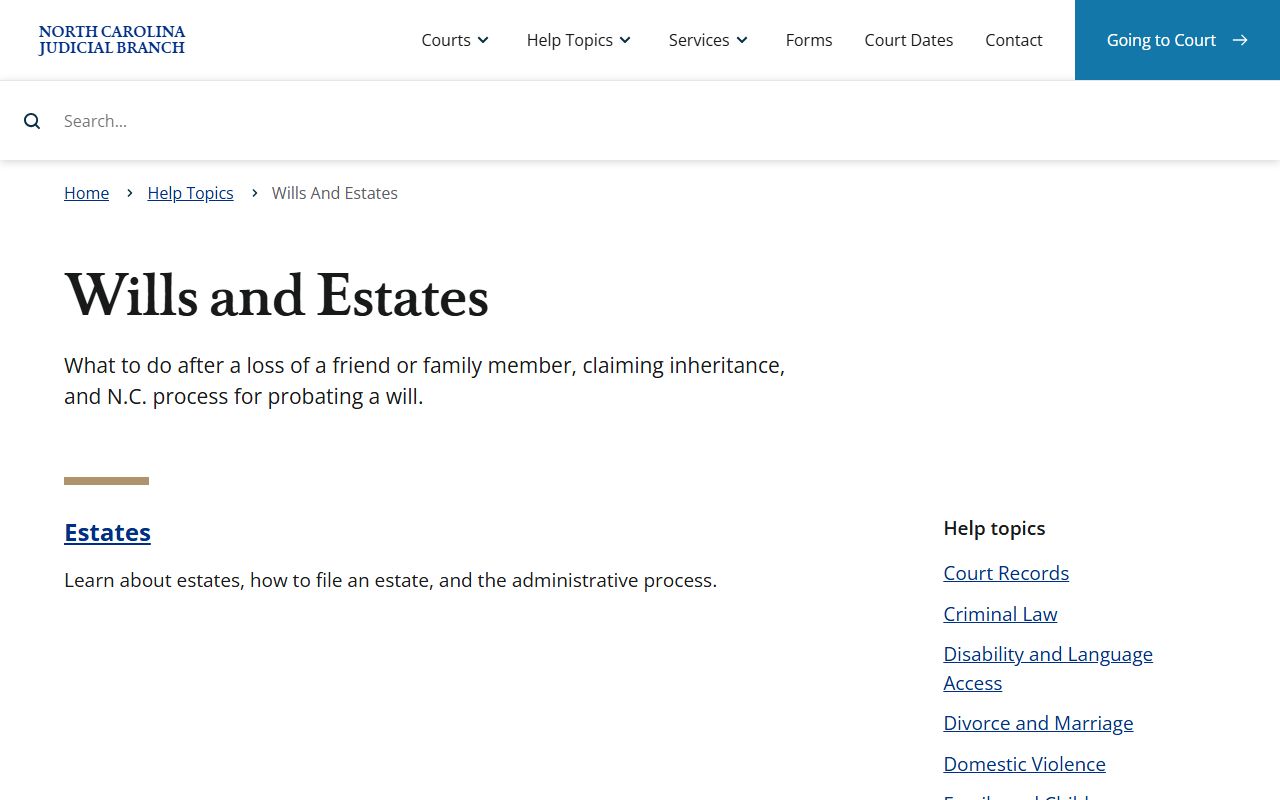
That statewide resource explains the probate framework, while Alleghany County filings and copies still run through the Sparta clerk's office.
Alleghany Probate Terms
Estate records use terms that are short but easy to misread. A probate search in Alleghany County may show a clerk file with a will, an application to administer an estate, a qualification order, or later filings from the personal representative. The definitions below keep the common terms tied to how the court record is used.
- Testator
- The person who made a will. A will filed in an estate record may identify the testator and the named executor.
- Executor
- The person named in a will to carry out estate duties after the clerk qualifies that person to act.
- Administrator
- A personal representative appointed when there is no valid will naming an executor, or when the named person cannot serve.
- Intestate
- A death without a valid will. The estate may still need a court file, but distribution follows North Carolina law rather than a will.
- Guardianship
- A court-supervised process for a minor or incapacitated adult. Access may be more limited than an ordinary estate file.
- Caveat
- A formal will contest. The research confirms that a caveat is heard by a Superior Court judge rather than handled as routine clerk administration.
Search Alleghany Probate Records
Public estate information follows the same access model used for North Carolina civil, special proceeding, and court records. The North Carolina eCourts Portal is the online path where available. The Judicial Branch public-record guidance also points users to public self-service terminals and paper files at the clerk's office in the county where the case was filed.
Alleghany County went live in eCourts as part of Track 9 in 2025. That matters for estate records because some newer case information may be searchable through the state portal, while paper documents that existed before conversion may still need in-person review at the clerk's office. The research did not verify public document downloads or a complete sample estate result screen, so a probate search should not assume every filed paper can be obtained online.
- Start with the NC eCourts Portal and search by party name or case details if known.
- Filter to Alleghany County when the portal offers a county or location filter.
- Use the courthouse public self-service terminal if the online search does not show enough detail.
- Ask the Clerk of Superior Court for the paper estate file or certified copies when an official document is needed.
- Use the mailing address only after confirming the case number, copy type, and fee with the clerk.
Note: Certified estate copies come from the clerk, not from a private search result or a screen print.
Alleghany Probate Contact
There is no separate Alleghany County probate courthouse identified in the research. The confirmed local probate channel is the Clerk of Superior Court at the Alleghany County Courthouse. The same office is also the local contact for civil files, criminal court files, special proceedings, divorce judgments, certified criminal searches, and many paper-file requests.
Clerk of Superior Court acting as ex officio Judge of Probate
Alleghany County Courthouse
12 N Main St
Sparta, NC 28675
336-372-3900
Monday-Friday, 8:00 AM-5:00 PM
Mailing: PO Box 61, Sparta, NC 28675
Call before bringing estate papers if the filing depends on a will, a death certificate, heir information, asset details, or a proposed personal representative. The official research did not locate Alleghany-specific appointment rules, so the clerk's phone line is the only confirmed local way to check scheduling.
Alleghany Probate Fees
Probate costs come from the statewide North Carolina court cost schedule. Alleghany County applies those court costs locally through the Clerk of Superior Court. Fees can depend on estate size, filing type, and the number or certification level of copies requested.
| Item | Amount |
|---|---|
| New estate administrations and estate proceedings | $120.00 plus gross-estate fee |
| Gross-estate fee | $0.40 per $100.00 of gross estate |
| Minimum gross-estate fee | $15.00 |
| Maximum cumulative gross-estate fee | $6,000.00 |
| Caveat for decedents dying on or after January 1, 2012 | $200.00 |
| Certified, exemplified, or plain copies | Confirm current miscellaneous copy cost with the clerk |
The current court costs publication is the statewide source for updates. Because estate fees can change and depend on the file, confirm the amount before mailing a payment.
Alleghany Estate File Contents
An Alleghany County estate file can include the application or petition, the will if one is filed, renunciation or qualification papers, letters appointing a personal representative, inventories, annual accounts, final accounts, creditor claims, notices, receipts, clerk orders, and correspondence. A file may be short for a small estate or more detailed when assets, creditors, heirs, and accountings require court review.
Guardianship and some special proceedings may also be handled by the clerk, but they are not always open in the same way as an ordinary estate. Records involving minors, incapacitated adults, medical facts, sealed documents, or protected information may require clerk review before access is granted.
The manifest source for estate administration is the North Carolina Judicial Branch estates guide.
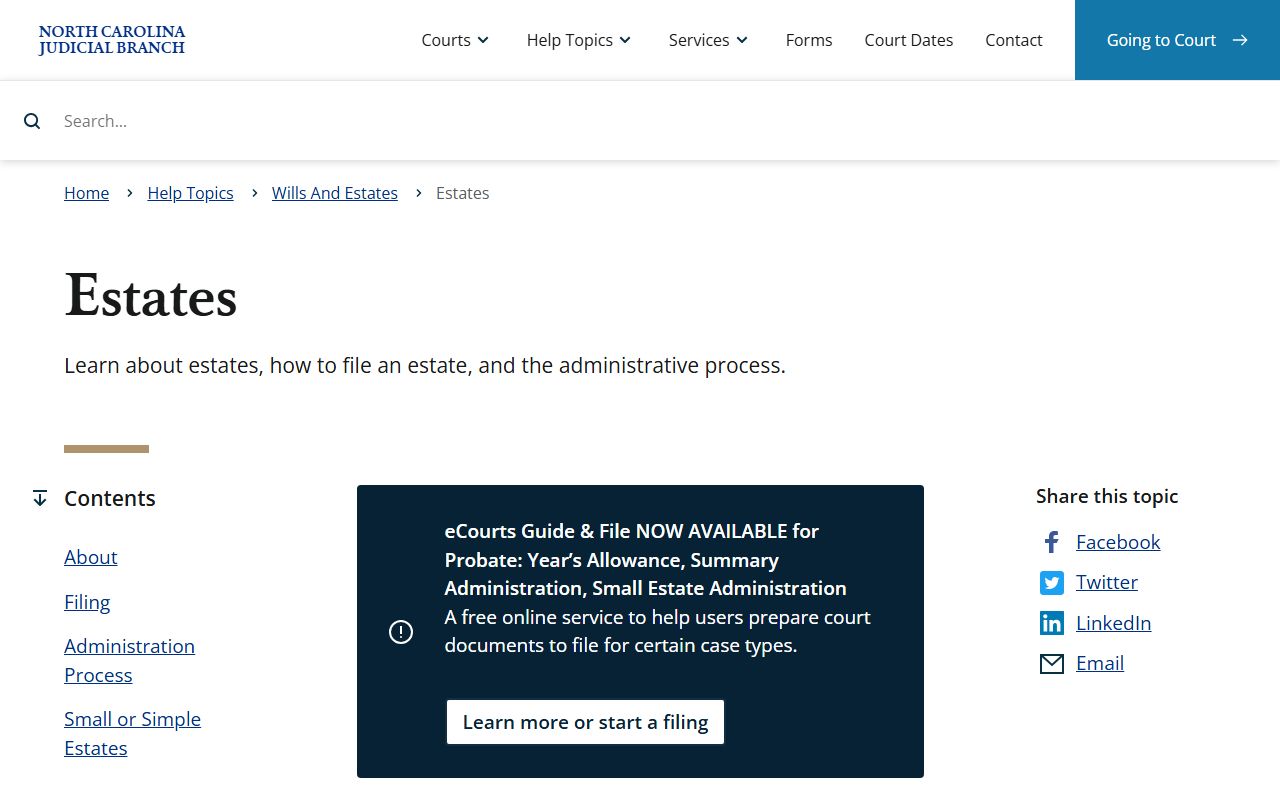
The statewide estates guide explains the probate role of the clerk, while the actual Alleghany County estate file remains with the local court office.
Alleghany Probate Process
Most estate work starts by deciding whether Alleghany County is the right county for the filing. The decedent may have lived in Alleghany County, owned property there, or otherwise had an estate matter that belongs in the local court file. When the county is correct, the person seeking authority should contact the clerk for the right procedure.
Typical estate flow: Confirm county › contact clerk › bring will and death certificate if applicable › file estate papers › pay opening costs › qualify personal representative › give notices › inventory assets › handle claims › file accountings › close estate.
That flow is not a substitute for clerk instructions. It is only the sequence reflected in the research. Local appointment scheduling, will-deposit practices, and packet details were not found in official Alleghany County sources.
Restricted Alleghany Probate Records
Probate records are often public, but not every estate-related filing is open without limits. Guardianship material, filings about minors or incapacitated adults, medical information, sealed documents, and certain special proceedings may have restricted access. A public terminal may show basic case information while withholding protected documents.
When access is unclear, the safest route is to ask the Clerk of Superior Court which parts of the Alleghany County probate file can be inspected, which copies can be certified, and whether a court order is needed. The clerk can also distinguish an estate record from a deed, death certificate, marriage record, or other document held by the Register of Deeds.