
Search Alleghany County Court Records
The main online search route for Alleghany County court records is the North Carolina eCourts Portal. The portal supports case search, hearing search, online payments, and judgment search for eCourts counties. Alleghany County joined eCourts on July 21, 2025 as part of Track 9, so current court records and court dates route through the same statewide system used by other North Carolina counties. The portal is useful for name, case number, citation number, and hearing searches, but it is not the only access channel.
The official Alleghany County Judicial Branch page points users to court dates, payment information, local forms, and the county contact directory. For a certified copy, a paper case file, a certified single-county criminal search, or a divorce judgment, the search often has to move from the portal to the Clerk of Superior Court. Paper documents that existed when eCourts went live may still be available in paper form at the clerk's office rather than as a complete online file.
- Start with the NC eCourts Portal and choose Smart Search for case information or Search Hearings for court dates.
- Enter a case number, citation number, party name, business name, attorney name, or judicial officer when that search type is available.
- Use Alleghany County as the location filter when the portal asks for a county or court location.
- Review the case status, hearing date, charge, claim, party, and disposition fields that are visible to the public.
- Contact the Clerk of Superior Court if the record needs a certified copy, a paper document, or a certified criminal record search.
The NC Judicial Branch county landing page is shown in the manifest as the official starting point for local services: Alleghany County court location.
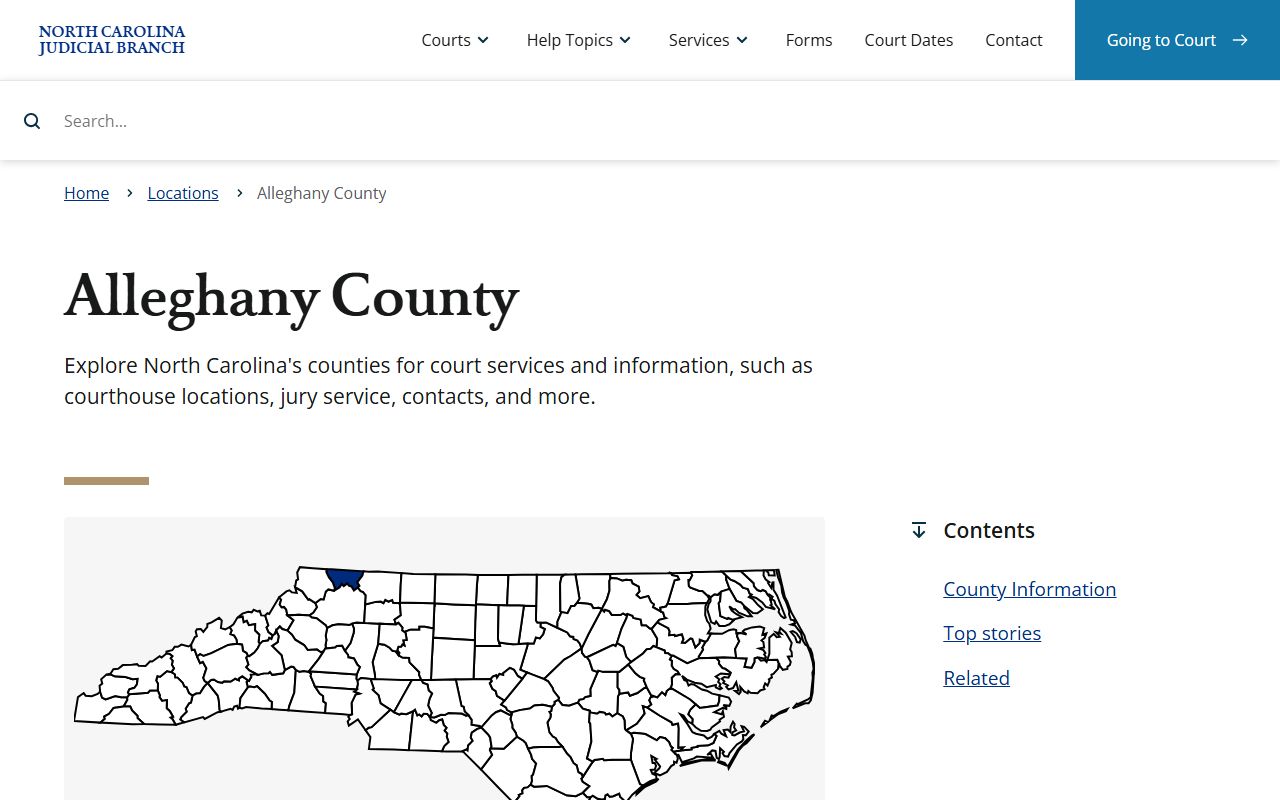
That local page matters because it gathers court dates, forms, payments, courthouse details, and contact links in one official county view.
Alleghany County Court Search Fields
Smart Search and Search Hearings use different fields. Smart Search is built for case and record lookup. Search Hearings is built for docket and court-date lookup. The live portal requires JavaScript, cookies, and a CAPTCHA challenge at intervals, so the safest approach is to keep search terms exact and use the county filter when possible. If a case is hard to find, try both the party-name path and the case-number or citation-number path.
| Field | Search Area | How It Helps |
|---|---|---|
| Record number or name | Smart Search | Searches by case number or by name in last, first middle suffix format. |
| Location | Smart Search and hearings | Filters results to Alleghany County instead of all North Carolina locations. |
| Case status and type | Smart Search | Narrows a broad search to open, closed, civil, criminal, estate, or other case groups when visible. |
| Hearing type | Search Hearings | Filters by civil, criminal, family, probate or mental health, based on the portal options. |
| Judicial officer or courtroom | Search Hearings | Helps locate a docket when the party or case number is not the best search key. |
The Alleghany court contact directory is another official county source for clerk, judge, district attorney, magistrate, and disability-access contacts.
Use the directory when a court record search turns into a phone request, an accessibility question, or a need to confirm the correct local office.
Alleghany County Court System
Alleghany County does not operate a separate county-created court system. It is part of North Carolina's unified General Court of Justice. The statewide structure has an Appellate Division, a Superior Court Division, and a District Court Division. Alleghany County is assigned to Prosecutorial District 34, Superior Court District 34, and District Court District 34. That district structure shapes where court records are filed, who prosecutes criminal cases, and which court handles a hearing.
Superior Court handles felony criminal cases, higher-value civil matters, some appeals, caveats, and other superior-level proceedings. District Court handles misdemeanors, infractions, traffic matters, juvenile cases, domestic matters, small claims through magistrates, and lower-value civil cases. Small Claims Court is part of District Court and is heard by magistrates without a jury. The Court of Appeals reviews trial-court proceedings for legal error rather than taking new evidence.
Case flow: Magistrate or District Court matter › District Court or Superior Court case › North Carolina Court of Appeals when an appeal is available › Supreme Court of North Carolina in limited matters.
| Court or Office | Alleghany County Role | Record Types |
|---|---|---|
| Superior Court | Primary trial court for felony and higher civil matters | Felony files, civil actions, superior proceedings, caveats, appeals from lower levels |
| District Court | Local trial division for many daily court matters | Misdemeanor, traffic, infraction, juvenile, domestic, and small-claims records |
| Clerk of Superior Court | Local court record custodian and probate officer | Court files, certified copies, estates, divorce judgments, certified criminal searches |
| Magistrates | Small claims, initial criminal proceedings, and other magistrate duties | Small claims, initial appearances, release conditions, and certain warrant-related records |
Alleghany County Courthouse Contacts
The courthouse in Sparta is the local state-court hub for Alleghany County court records. It houses the Clerk of Superior Court and is the point of contact for many court copy, payment, public terminal, and paper file questions. County records are not all in the same building, though. The Law Enforcement Center handles sheriff and jail matters, while the County Administration Building houses the Register of Deeds for marriage records, birth and death records, deeds, plats, and recorded instruments.
Alleghany County Courthouse
12 N Main St
Sparta, NC 28675
336-372-3900
Monday-Friday, 8:00 AM-5:00 PM
Alleghany Law Enforcement Center
40 Alleghany Street
Sparta, NC 28675
336-372-4455
Office manned 24/7; business during weekday hours
Register of Deeds
348 South Main Street, Office 110
Sparta, NC 28675
336-372-4342
Marriage applications accepted until 4:30 PM
The courthouse image comes from the official Judicial Branch courthouse source: Alleghany County Courthouse.
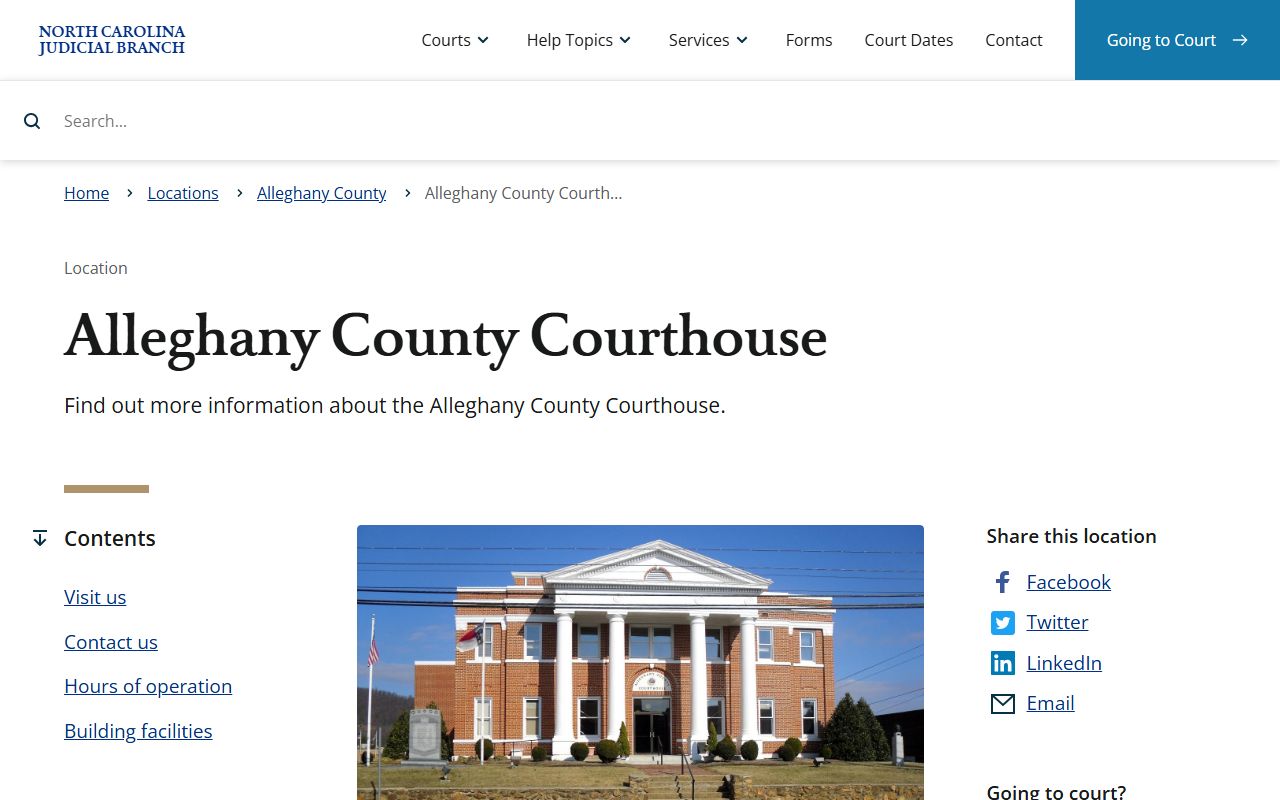
The courthouse page confirms the court address, mailing address, phone number, hours, and wheelchair-access facility listing.
Alleghany County Court Record Types
Alleghany County court records include civil cases, criminal cases, court charges after arrest, traffic and infraction cases, domestic matters, divorce judgments, estate files, special proceedings, dockets, judgments, and court-cost records. The same person may need more than one office. A divorce judgment is a court record from the Clerk of Superior Court. A marriage license or certified marriage copy is a Register of Deeds record. A current custody check may require the jail, NC SAVAN, VINELink, or the state offender search, depending on custody type.
- Civil records: complaints, summonses, answers, motions, orders, judgments, notices, and settlement or hearing entries.
- Criminal court records: charges, appearances, pleas, bonds, dispositions, judgments, sentences, probation terms, fines, and costs.
- Dockets: hearing dates, court sessions, party names, hearing types, courtrooms, case numbers, and judicial officer filters when available.
- Traffic records: citation number, charge, court date, waiver or plea, disposition, fines, costs, and compliance status.
- Estate records: probate applications, wills, inventories, accountings, claims, orders, notices, and personal representative filings.
Alleghany County Court Record Details
A typical Alleghany County court record can show the record number, county, court division, case type, filing date, party names, attorney names, hearing dates, claim or charge details, case status, docket events, financial obligations, and disposition. Public visibility depends on the case type, access level, redactions, sealing rules, and whether the document is an older paper item from before the eCourts transition.
| Field | What It Shows |
|---|---|
| Case or record number | The identifier used for Portal search, clerk requests, and court-date lookup. |
| Party name | A person, business, plaintiff, defendant, petitioner, respondent, or other party tied to the case. |
| Case type and status | The broad category and whether the matter is open, closed, disposed, pending, or otherwise marked. |
| Hearing information | Dates, hearing type, courtroom, judicial officer, and event information when public and available. |
| Charge or claim | The offense, citation, civil claim, estate issue, or proceeding type at the center of the file. |
| Disposition or judgment | The outcome, sentence, order, money judgment, dismissal, or other final court action. |
Alleghany County Public Access Laws
North Carolina public access starts with the state's public-records law, but court files also have court-specific rules. G.S. 132-1 defines public records broadly. G.S. 7A-109 requires clerks to maintain records, dockets, indexes, and files, and it makes them open to public inspection during regular office hours unless another law restricts access. The practical result is a mixed access model: portal search first, then public terminals, paper files, certified copies, or a local clerk request when online access is incomplete.
Key Statutes:
G.S. 132-1 defines North Carolina public records for public business.
G.S. 132-1.4 limits access to criminal investigation and criminal intelligence records.
G.S. 7B-3000 treats juvenile court records differently from ordinary adult court files.
G.S. 7B-2901 makes abuse, neglect, and dependency records confidential except as authorized by law.
Restricted Alleghany County Court Records
Not every Alleghany County court record is open in the same way. Juvenile delinquency and undisciplined records, abuse and neglect records, adoption records, mental health or commitment matters, sealed filings, expunged cases, personal identifiers, and some law-enforcement investigation records have limits. A public portal search may not show those records, and the clerk cannot release documents when a statute or court order closes them.
Expunction also changes public access. North Carolina law has expunction paths for certain dismissed charges, not-guilty findings, and eligible nonviolent misdemeanor or felony convictions. The filing usually starts in the county where the charge or conviction occurred. Eligibility depends on the exact offense, disposition, waiting period, prior record, and statutory exclusions. A public search should not be expected to reveal an expunged entry after the court order and agency processing are complete.
Alleghany County eCourts Change
Alleghany County became an eCourts county on July 21, 2025. The Track 9 launch brought eFiling, Portal, and Enterprise Justice/Odyssey to Alleghany and other northwestern or mountain counties. The transition changed the lookup path for new and active matters, but it did not turn every old paper document into an online image. The Track 9 notice said legacy systems would be decommissioned for inquiry and update after go-live, while paper documents that existed at go-live remained available in paper form through the clerk's office.
The statewide services hub is another source for portal, filing, payment, and court service links: NC Judicial Branch services.
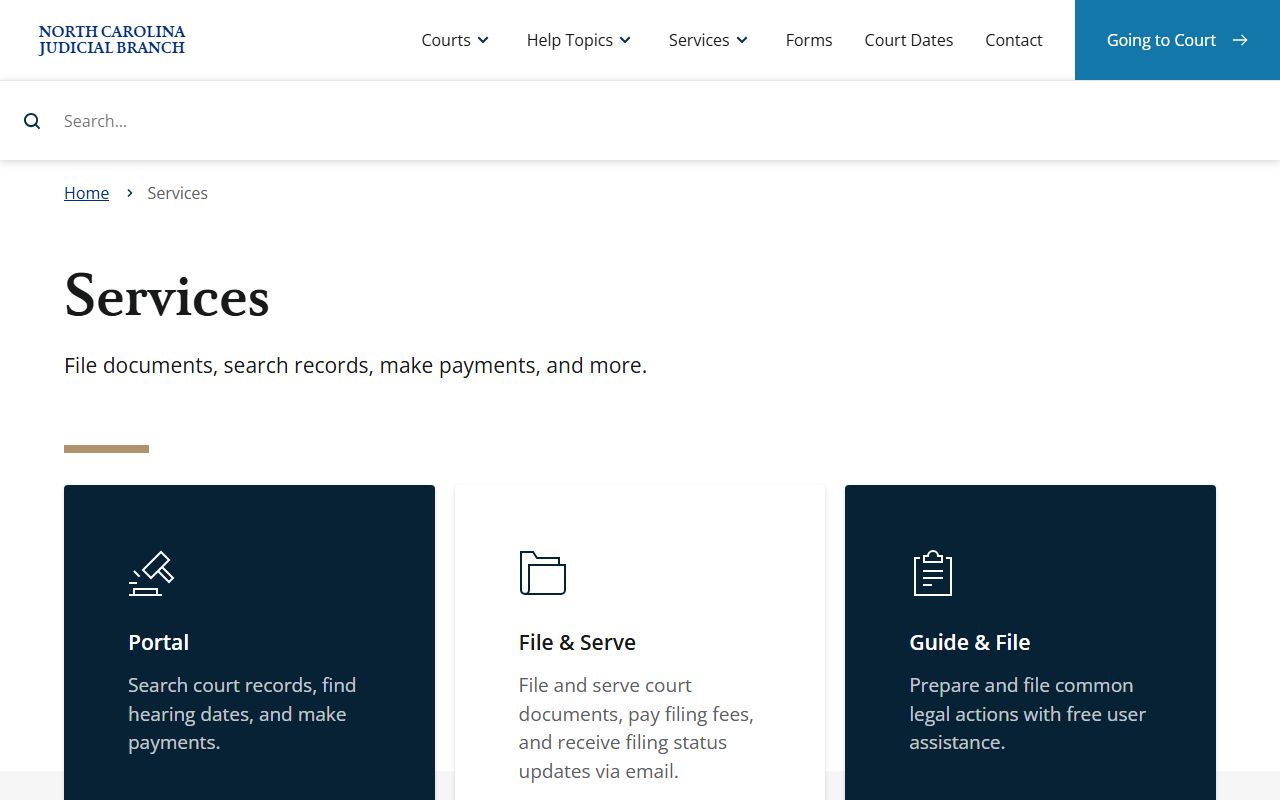
The services page helps separate online court tools from local clerk functions that still require a county office or paper-file request.
Note: Portal search is helpful for public lookup, but certified court records still come from the clerk or official custodian.
Alleghany County Sheriff and Jail Records
The Alleghany County Sheriff's Office operates from the Law Enforcement Center in Sparta. The office serves warrants, subpoenas, summonses, writs, and civil process; provides court security; extradites prisoners; operates the county jail; and shares law enforcement responsibility inside the Town of Sparta with the Sparta Police Department. The official page names Acting Sheriff Shane Glenn and identifies John Abernathy as chief jailer.
No official online Alleghany County jail roster was found in the research. County jail questions should start with the Law Enforcement Center, while state prison, probation, parole, and historical offender records route through the NC Department of Adult Correction offender search hub. NC SAVAN and VINELink can help with custody notification. The state offender search does not replace a county jail roster, and the jail should be called before relying on visitation, mail, commissary, or custody details.
Alleghany Marriage Divorce Probate
Marriage records and marriage licenses are Register of Deeds records in Alleghany County. Divorce judgments are court records obtained from the Clerk of Superior Court in the county where the divorce was granted. Probate is also local to the court system, but North Carolina does not use a separate county probate court. The Clerk of Superior Court acts as ex officio judge of probate, and assistant clerks handle many estate proceedings.
Alleghany's formation in 1859 matters for family and land research. The Register of Deeds notes that land records and marriage records before 1859 may be found in the Ashe County Register of Deeds office. That does not change where current Alleghany court records are filed, but it is a key fact for genealogy, title, and older marriage searches.
- Estate
- The court process for handling a deceased person's property, debts, notices, and distribution.
- Caveat
- A will contest that challenges whether a will is valid.
- Certified copy
- A copy authenticated by the clerk or official custodian as a true copy.
Alleghany County Court Record Fees
Court and record fees come from statewide cost charts and local custodian rules. Certified single-county criminal record searches are requested through the Clerk of Superior Court with AOC-CR-314. Register of Deeds fees are separate and apply to marriage, vital, deed, and recorded-instrument records rather than court case files. Check the current court costs page before filing or requesting a copy because the Judicial Branch updates statewide cost publications.
| Item | Amount or Rule |
|---|---|
| Certified single-county criminal record search | $25.00 through the Clerk of Superior Court |
| Certificate under seal | $3.00 |
| Exemplification of records | $10.00 |
| Preparation of copies | $2.00 first page of each document; $0.25 each additional page |
| Absolute divorce filing | $75.00 |
| Marriage license | $60.00 through the Register of Deeds |
Alleghany County Traffic Records
Traffic cases in Alleghany County are generally District Court records. A court traffic record is not the same as a DMV driver record. The court file shows the citation case, charge, court date, waiver or plea, disposition, fines, costs, and compliance status. The driver record shows license status, points, suspensions, convictions, and administrative consequences maintained by the licensing authority.
The Alleghany payment page says court fees, fines, and eligible traffic citations can be paid online, in person, or by mail. Mail payments must be by money order or certified check payable to Alleghany County Clerk of Superior Court, and an eligible traffic citation payment should include the citation number. Personal checks and cash are not accepted by mail.
Alleghany County Court History
Alleghany County was formed from Ashe County by an act of the 1858-1859 session of the North Carolina legislature. That history has direct record-search value. Marriage and land records before 1859 may be in Ashe County rather than Alleghany County, while current court cases, divorce judgments, estate files, criminal searches, and traffic matters route through the Alleghany court system in Sparta.
The county homepage is a current local government source: official Alleghany County homepage.
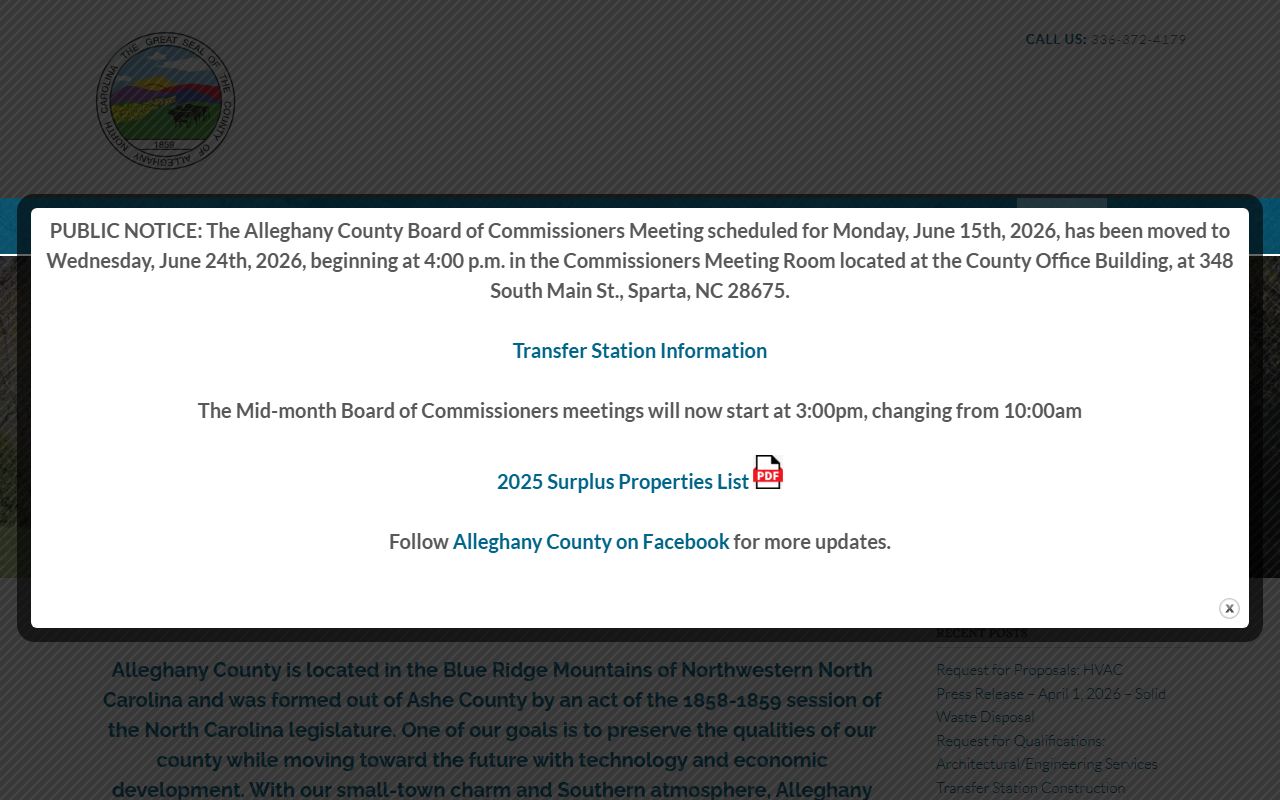
The county page provides local context for the courthouse, county offices, public notices, and the split between court records and county administration records.
Alleghany County Court Records FAQ
Can Alleghany County court records be searched online?
Yes. Public case information and hearing searches start with the NC eCourts Portal. Use the county filter, a party name, case number, citation number, or hearing search fields. Certified copies and some paper documents still require the Clerk of Superior Court.
Where are Alleghany divorce records kept?
Divorce judgments are court records. Use the Clerk of Superior Court in the county where the divorce was granted. Marriage licenses and certified marriage copies are handled by the Register of Deeds, not the court clerk.
Is there an Alleghany County online warrant list?
No official online active warrant list was found in the research. Warrant-related questions should be handled through the Sheriff's Office, Clerk of Superior Court, magistrate contact, court records, or an attorney.
Does the NC offender search show county jail inmates?
No. The NC Department of Adult Correction search is for state prison, probation, parole, and historical offender records. County jail custody should be confirmed with the Law Enforcement Center or notification systems such as NC SAVAN or VINELink when available.